
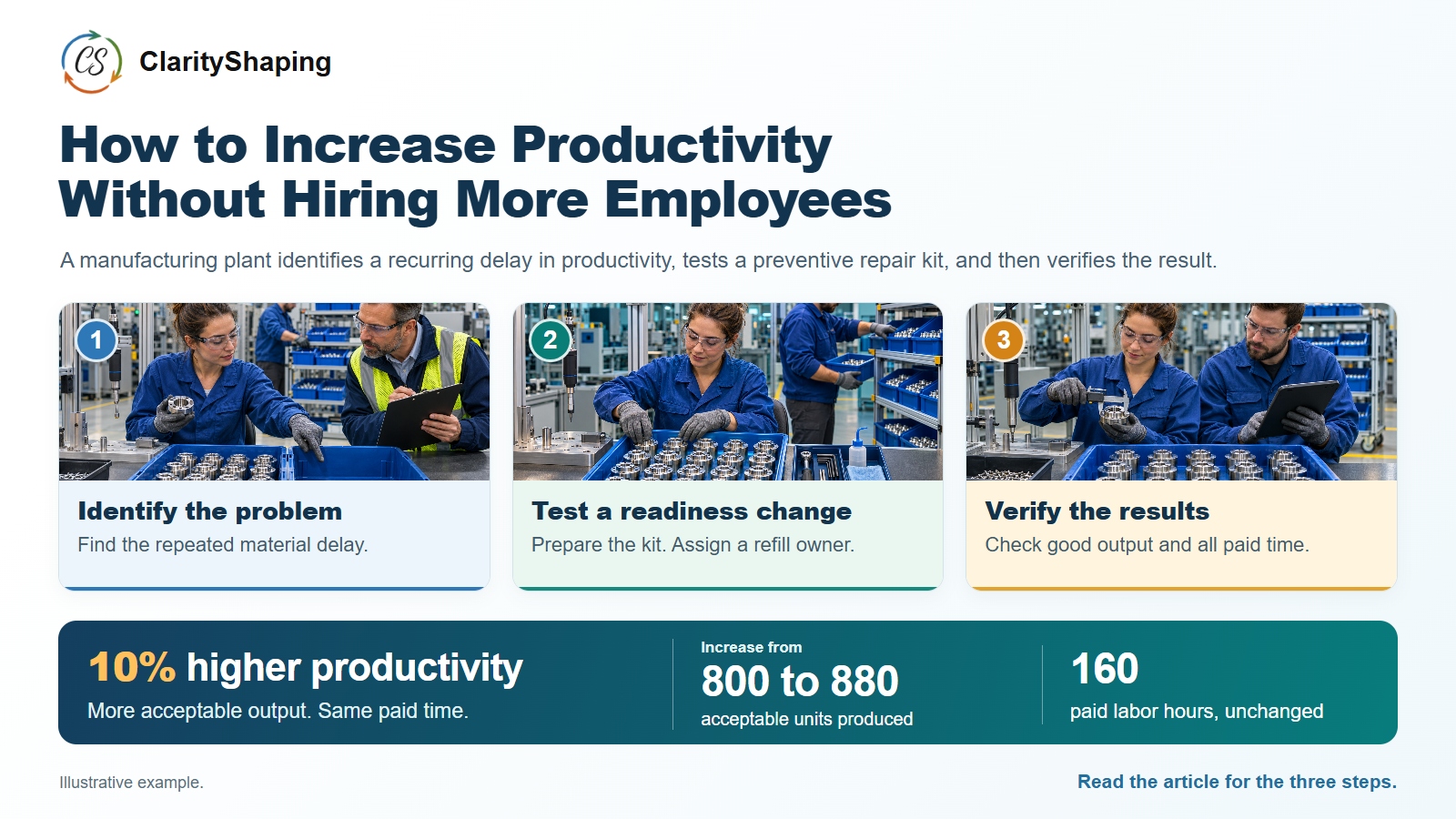
How can a leader increase good quality output without immediately adding people? Start with one recurring problem, understand the root cause behind why it is happening, test a change on a small scale, then roll out a full change to all. Worth a try to see how it can increase productivity without hiring more employees?
In the manufacturing industry, productivity describes how much acceptable output a plant can produce for the time and resources it uses. Many factors could be at play to limit productivity. For example, a team can appear busy, but a closer look shows a large share of its paid time goes to searching, waiting for a forklift, or entering the same information twice. Observe the interaction between people, machines, and material instead of asking everybody to work faster. In this article we use an example manufacturing production leader to illustrate the concept.
1. Identify the problem and define the baseline
Start by identifying the problem and measuring the baseline. Record accepted units, all paid hours supporting the cell, material shortages, repair work, and unfinished orders. Include the material handler rather than moving that person’s work outside the calculation.
In our example manufacturing plant, the production leader identifies the problem and then chooses one assembly team (Team A) for the baseline measurements. Team A makes 800 acceptable units (good quality that can be sent to customers) in 160 paid labor hours (production time). During the production time, Team A operators note that missing components interrupt production assembly tasks.
The baseline measurement should include at a minimum:
- The product family, relevant production opportunities and start and finish boundaries.
- The counts, elapsed time and expense records behind the current result, including exceptions.
- The customer requirements and operating conditions that must remain protected during the trial.
2. Make one change and test it
Research best practices, talk with your team, and find a potential improvement. Then test the improvement while keeping everything else constant. In our manufacturing example, the leader tests a different way to prepare and replenish materials. For the change, Team A prepares one approved component kit before the shift and assigns a refill owner. The leader watches whether operators can continue the normal assembly sequence without spending time searching for spares. This additional advanced preparation should make the work more reliable, rather than require a faster pace that the team cannot safely sustain. The test results showed that the same Team A is able to produce 880 good units in the same hours with the new production method.
Only change one variable at a time. The paid production hours remain at 160, so the extra 80 acceptable units cannot be explained by more recorded labor. The leader should confirm that a supervisor or temporary employee did not supply unrecorded support during the test period.
How to decide what change to make? Use the ideas below to get started.
Observe the work
Ask operators where they lose time. Are they searching for samples, waiting on materials, or spending large amounts of time on paperwork?
Prepare materials at the point of use
Test a material refill location or repair station. Avoid moving all inventory to the line and creating congestion.
Balance the workload
Compare task times with demand and identify safe task redistribution. Include breaks, training and required checks before assuming labor is available.
Cross-train for coverage
Build a skills matrix and verify task competence through observed performance. Give supervisors a plan for absence coverage without removing required qualifications.
Measure the result
Compare good units per labor hour on a similar mix. Check overtime, injuries, first-pass yield and operator feedback before extending the change.
3. Verify the result and make it repeatable
Compare the final production results with the original baseline measurements. If the production change is verified, then make it repeatable to other teams and business areas. In our manufacturing plant example, check that the additional 80 units produced pass the same acceptance requirements as the other 800, and that another department did not absorb unrecorded work.
Measure the change in labor productivity, while keeping all other variables constant. (Labor productivity = good units ÷ paid labor hours.) In our manufacturing plant example:
- Acceptable production output rises from 800 to 880 units in the same 160 paid labor hours.
- Productivity increases from 5.0 to 5.5 acceptable output units per paid hour, a 10% gain.
- The result is more capacity to put towards a production backlog or identified staffing need, with payroll savings only when paid expense actually falls.
Team A’s illustrative costs and benefits
What could the productivity gain mean for the business? Add a financial layer to the same Team A example. These are illustrative assumptions, not actual costs or measured financial results:
- Paid labor costs $30 per hour, with 160 total paid labor hours in both comparisons, including kit preparation and replenishment.
- Each of the 80 additional good units can be sold and provides $8 of contribution after its added materials and other variable production costs.
- The prepared-kit arrangement requires a $200 one-time purchase of bins and supplies, with no added recurring expense in this example.
Paid labor cost is 160 × $30, or $4,800, both before and after the change. That means there is no payroll saving in this comparison. The potential business benefit comes from selling more good units with the same paid time.
Selling all 80 additional units produces 80 × $8, or $640 of added contribution. Subtracting the $200 one-time kit cost leaves a potential $440 net benefit in the first comparison period. The unchanged paid labor cost is already present in both comparisons, so do not deduct it again from the added contribution.
This period has not been defined as a week or a month, so the example does not establish a monthly or annual benefit. Without demand for the additional output, the 10% productivity gain is extra capacity, not the $440 financial result. Verify actual costs and sales before claiming a financial benefit.

Repurpose the saved time
Use the recovered capacity to work a production backlog, reduce overtime, complete preventive tasks, cross-train people for a known coverage gap, or fill an identified staffing need. Don’t immediately jump to a financial savings, but rather use the additional capacity to solve another problem, and then celebrate the financial savings.
Additional staff
In some cases, the work load still exceeds possible capacity after all changes are implemented. It could be the gap between customer demand and productive output is larger than a process change can address. In that case, the evidence supports hiring. Process improvement should clarify that decision, and help determine the number and level of additional staff needed, rather than become an automatic argument against needed staff. Include all business groups when verifying the result.
- Production confirms the same measurement boundary and explains changes in demand, mix and staffing.
- Quality confirms acceptance requirements and checks whether rejects, repair or customer problems have shifted.
- Finance distinguishes actual avoidable expense from capacity or time value and removes overlapping benefit claims.
- The operating owner maintains instructions, checks the condition that supports the gain and responds when performance deteriorates.
What’s next?
Choose one repeated productivity interrupter that prevents your existing team from making the needed level of acceptable output. Measure the baseline. Identify and test the change. Verify before making it repeatable. A conversation with ClarityShaping can help define the problem, evaluate the evidence, and identify an appropriate next step.
Contact ClarityShaping to discuss a practical next step for your plant
Manufacturing leader FAQs
What should we bring to the first review?
Bring recent records for material waiting in the assembly cell, the current method, a representative example and the customer or business requirement being missed. Start with the raw data counts and timestamps behind the summary. Agree which costs can genuinely change before converting an operating result into a financial result.
When is the change ready to expand?
Expand after comparable operating evidence supports the result, required quality and delivery conditions remain acceptable, and the operating owner can demonstrate the approved method. Include affected shifts and relevant product variants. If the pilot misses its aim, revise the explanation or trial rather than extending the original savings assumption.
Research Links
Lean Enterprise Institute distinguishes overall process efficiency from local station efficiency and explains that extra output has different value when customer demand does not increase. Productivity decisions therefore need a demand check.
Lean Enterprise Institute efficiency
Lean Enterprise Institute describes standardized-work combination tables that distinguish manual activity, walking and machine processing. These categories help reveal whether a proposed labor balance can actually be performed.
Lean Enterprise Institute standardized work
About the author
ClarityShaping brings Lean Six Sigma Black Belt credentials and 15+ years of Lean Six Sigma process improvement experience across government, banking, small business, and manufacturing.

