CLARITYSHAPING | MANUFACTURING PROCESS IMPROVEMENT
Your manufacturing plant may be producing more than ever, but is it making more money? Companies often have hidden operational inefficiencies that reduce manufacturing profitability. Implementing strategic process improvements can help you recover lost profits.
Manufacturing companies face a challenging balancing act: rising material costs, workforce shortages, equipment maintenance, production deadlines, and increasing customer expectations. Even when sales are strong and production lines are busy, profitability can remain frustratingly low.
For many manufacturers, the problem isn’t a lack of customers or insufficient production capacity. It’s the hidden inefficiencies buried within their daily operations. Excessive downtime, unnecessary material waste, inefficient workflows, inconsistent processes, and poor production planning can quietly erode profit margins. Individually, these issues may seem manageable. Collectively, they can cost a manufacturing business hundreds of thousands of dollars annually, depending on the size and complexity of its operations.
The encouraging news? Many of these problems can be addressed without purchasing expensive new equipment, expanding facilities, or hiring additional employees. By identifying operational inefficiencies and implementing targeted manufacturing process improvements, companies can improve productivity, reduce unnecessary expenses, and create more profitable operations.
1. You’re Producing More, but Not Necessarily Earning More
A big misconception in manufacturing is that increased production automatically leads to increased profitability. While higher production volumes can improve economies of scale, they can also magnify existing operational problems.
Consider a manufacturing facility that increases production by 20% but simultaneously experiences:
- Higher overtime expenses.
- Increased equipment wear and maintenance costs.
- More defective products and rework.
- Greater raw material consumption.
- Increased inventory holding costs.
- More frequent production scheduling conflicts.
Despite producing more products, the company may experience declining profit margins. Rather than focusing exclusively on production volume, manufacturers should evaluate the financial performance of their production processes.
Important metrics include:
- Contribution margin per unit: How much each unit contributes toward fixed costs and profit after variable expenses.
- Cost per good unit: The total production cost divided by the number of acceptable units produced.
- First-pass yield: The percentage of products manufactured correctly without rework.
- Overall Equipment Effectiveness (OEE): A measure of equipment availability, performance, and quality.
- Operating profit margin: The percentage of revenue remaining after operating expenses.
A profitable manufacturing operation isn’t necessarily the one producing the most units. It’s the one consistently delivering quality products at an economically sustainable cost.
2. Hidden Production Bottlenecks Are Limiting Your Profitability
Every manufacturing process has constraints that determine how efficiently products move through production. These constraints, commonly called production bottlenecks, can create significant financial consequences. A bottleneck might involve an aging machine, an understaffed department, an inefficient approval process, or a production stage that consistently takes longer than others.
When bottlenecks aren’t properly identified and addressed, manufacturers often experience excessive work-in-progress inventory, missed deadlines, overtime, and idle equipment.
Example: The expensive bottleneck nobody noticed
The illustrative example below shows a manufacturing plant with five production stages but one is limiting production capacity.

The solution: Identify the true production constraint and focus improvement efforts where they will have the greatest impact on overall system performance. Manufacturers can accomplish this through process mapping, cycle-time analysis, value stream mapping, and systematic constraint management.
3. Material Waste and Rework Are Quietly Destroying Your Margins
Manufacturing waste is often treated as an unavoidable cost of doing business. But excessive scrap, rejected products, and rework represent lost opportunities for profitability. Waste doesn’t just include discarded raw materials. It also includes labor, equipment time, energy, and production capacity consumed by products that cannot be sold at full value.
What is the real cost of manufacturing waste?
Consider the hypothetical example illustrated below.

Even relatively small improvements can produce meaningful financial benefits.
How manufacturers can reduce waste
Effective waste reduction begins with understanding why defects and unnecessary material consumption occur. Common improvement opportunities include standardized work procedures, equipment calibration, employee training, supplier quality improvements, preventive maintenance, and root cause analysis.
The goal isn’t simply to produce less scrap. It’s to build a manufacturing process that consistently produces acceptable products the first time.
4. Equipment Downtime Is Costing More Than You Realize
Unexpected equipment downtime is one of the most expensive challenges facing manufacturing operations. When critical machinery stops functioning, the financial impact often extends far beyond the cost of repairing the equipment. Downtime can result in idle labor, lost production opportunities, expedited shipping, missed customer deadlines, overtime, and disrupted production schedules. Yet many manufacturers don’t accurately calculate their total cost of downtime.
A better approach to equipment performance
Manufacturers should establish a systematic approach to tracking equipment availability and reliability. This includes measuring unplanned downtime, mean time between failures (MTBF), mean time to repair (MTTR), and overall equipment effectiveness. In addition, companies should determine which equipment failures have the greatest financial impact. Critical production equipment may justify more advanced preventive or predictive maintenance, while less critical equipment may require simpler maintenance schedules. By aligning maintenance investments with operational risk, manufacturers can improve equipment reliability while controlling costs.
5. Your Employees May Be Working Hard, but Your Processes Are Working Against Them
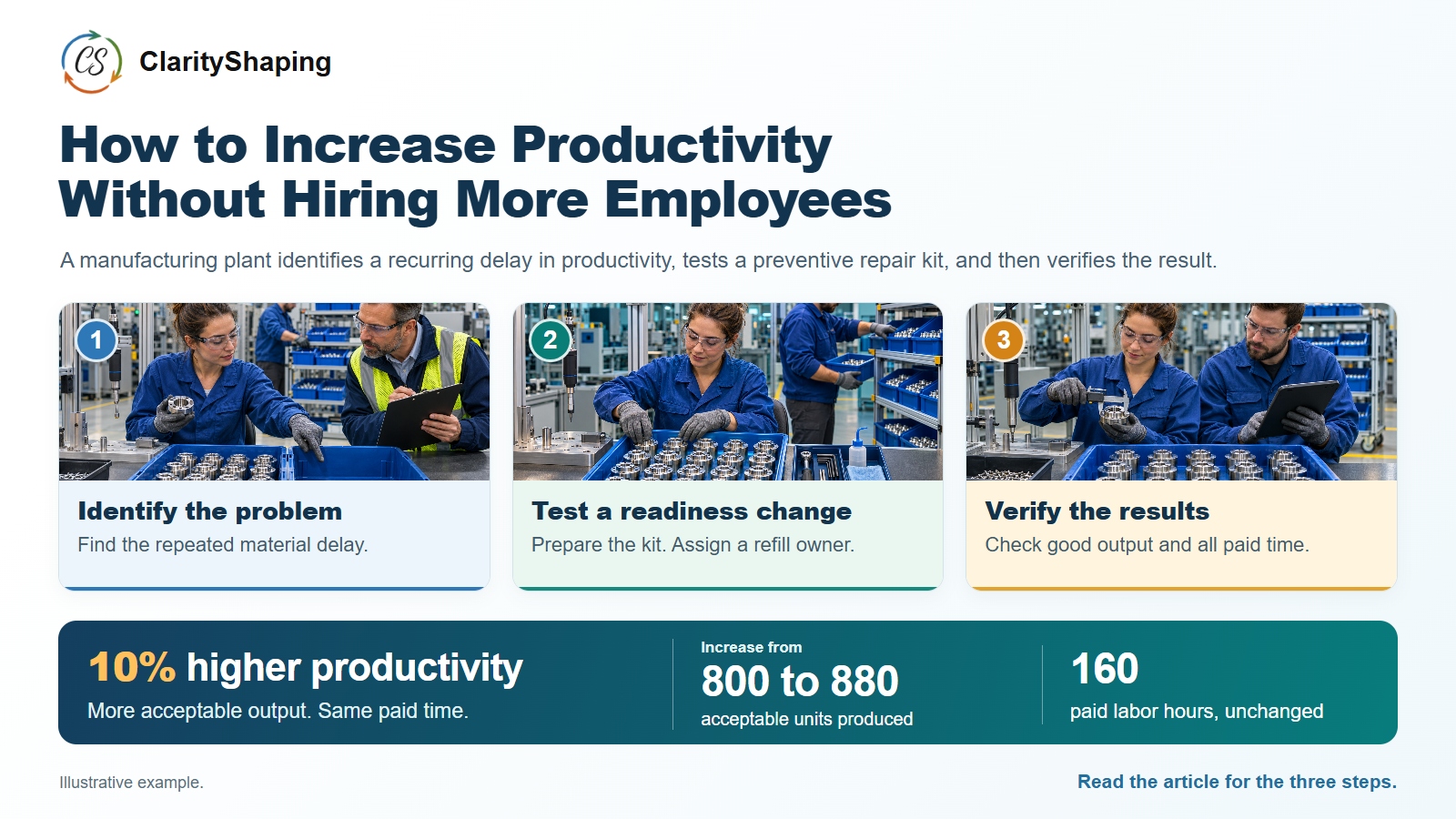
When productivity falls short of expectations, manufacturing leaders sometimes assume they need more employees, better employee performance, or additional supervision. The real issue may be the processes employees are required to follow. Consider employees who regularly experience missing materials, unclear instructions, poorly organized workstations, frequent production changes, or delays waiting for approvals. Even highly skilled employees struggle to maintain productivity in an inefficient system.
Improving labor productivity without increasing headcount
Before expanding the workforce, manufacturers should evaluate how employees spend their time throughout the production process. Ask questions such as:
- How much time is spent producing value versus waiting?
- Are employees regularly searching for tools or materials?
- Are work instructions consistent across shifts?
- Are employees performing unnecessary movements or repetitive administrative tasks?
- Could better scheduling or workstation layouts eliminate wasted time?
Lean manufacturing techniques, including 5S workplace organization, standardized work, and workflow optimization, can help companies improve labor productivity. The objective should be to make it easier for employees to perform their jobs effectively, not simply demand that they work harder.
6. Poor Production Planning Creates Expensive Operational Chaos
When schedules constantly change, materials arrive late, or departments operate without coordination, costs can escalate quickly. Poor planning may lead to excessive overtime, emergency material purchases, inefficient changeovers, unnecessary inventory, and missed delivery commitments. These expenses can become normalized because the business has operated this way for years.
Signs your production planning needs improvement
A manufacturing company may have scheduling problems if:
- Production priorities change daily
- Employees frequently wait for materials
- Jobs are consistently expedited
- Inventory levels are high despite material shortages
- Departments regularly blame one another for delays
Improving production planning requires greater visibility into demand, equipment capacity, labor availability, inventory, and production constraints. Manufacturers can begin with relatively straightforward improvements, including standardized scheduling processes, better communication between departments, realistic capacity planning, and clear performance metrics. Advanced scheduling software may eventually be appropriate, but software alone won’t fix a poorly designed planning process.
7. You’re Tracking Production Metrics, but Not the Right Ones
Manufacturing facilities often collect enormous amounts of operational data. Unfortunately, collecting data doesn’t necessarily mean using it effectively. Some manufacturers focus heavily on production output while overlooking the metrics that explain whether their operations are becoming more profitable. For example, a facility may celebrate achieving its monthly production target even though overtime costs increased, scrap rates rose, and customer returns exceeded expectations.
Manufacturing KPIs that deserve attention
| KPI | What it tells you |
| Overall Equipment Effectiveness (OEE) | How effectively equipment performs against its planned production potential |
| First-Pass Yield | How much production meets quality standards without rework |
| Cost per Good Unit | What it costs to produce each acceptable finished unit |
| On-Time Delivery | Whether production is meeting customer commitments |
| Scrap and Rework Cost | How much defective production is costing the business |
| Throughput | How much saleable output the production system generates |
| Inventory Turnover | How efficiently inventory is being managed |
| Contribution Margin | How much production contributes toward fixed costs and profit |
The key is connecting operational performance with financial outcomes. A production improvement that increases throughput but also substantially increases cost may not deliver the expected financial benefit. Likewise, reducing costs in one department can create larger problems elsewhere if the change disrupts the overall production system.
8. Your Continuous Improvement Efforts Aren’t Producing Lasting Results
Many manufacturing organizations have attempted Lean Manufacturing, Six Sigma, Kaizen events, or other continuous improvement initiatives. Some experience early success but struggle to maintain improvements over time. Why? Because process improvement isn’t simply about identifying problems and implementing solutions. It’s about creating systems that sustain better performance.
Common reasons improvement initiatives fail include insufficient leadership involvement, unclear accountability, inadequate employee engagement, unrealistic timelines, and a lack of ongoing performance measurement.
How to make improvements stick

9. You’re Making Major Investments Before Fixing Existing Processes
When manufacturing companies struggle to meet production demands, leadership may consider purchasing new equipment, expanding facilities, implementing advanced automation, or increasing staffing. If existing processes are inefficient, adding capacity may simply allow the company to produce waste faster. For example, purchasing an additional machine won’t necessarily improve profitability if the true production constraint involves material availability, scheduling, or quality control.
Before committing substantial capital, manufacturers should evaluate whether existing resources are being utilized effectively. A structured operational assessment can reveal opportunities to improve capacity, productivity, and profitability through process redesign rather than major capital expenditures.
10. You Haven’t Quantified the Financial Value of Process Improvement
Perhaps the most overlooked opportunity in manufacturing profitability is the failure to connect operational improvements with measurable financial results. Manufacturing leaders often recognize that certain processes are inefficient, but they may not know exactly how much those inefficiencies are costing the business. Without that information, it becomes difficult to prioritize improvement projects or justify investing in operational changes.
Consider the financial impact of small improvements

The larger point is that manufacturing profitability improvements don’t always require dramatic organizational changes. Multiple targeted operational improvements can collectively create substantial financial value.
How to Know Whether Your Manufacturing Plant Needs a Process Improvement Assessment
If your manufacturing business is experiencing any of the following challenges, it may be time to take a closer look at your operations:
- Revenue is growing, but profit margins are stagnant or declining.
- Production frequently falls behind schedule.
- Overtime expenses continue increasing.
- Equipment downtime regularly disrupts operations.
- Scrap and rework costs are higher than expected.
- Employees spend excessive time waiting for materials or instructions.
- Inventory levels are growing without corresponding improvements in sales.
- Previous improvement initiatives haven’t delivered sustainable results.
- Leadership struggles to identify which operational problems should be addressed first.
These challenges don’t necessarily indicate that your business needs a complete operational overhaul. They may simply mean that the company needs a clearer understanding of where inefficiencies exist and which improvements will generate the greatest return.
The Bottom Line: Manufacturing Profitability Starts With Better Processes
Manufacturing profitability isn’t determined solely by how much a company sells or produces. It’s also determined by how efficiently the organization converts labor, materials, equipment, and time into products that customers are willing to purchase. By evaluating production workflows, identifying bottlenecks, measuring operational performance, and implementing targeted improvements, manufacturing companies can strengthen profitability while building more resilient operations. The most profitable manufacturing plants aren’t necessarily the ones with the newest equipment or the largest workforce. They’re the ones that consistently understand, measure, and improve how their operations perform.
Ready to Discover What’s Holding Back Your Manufacturing Profitability?
At Clarity Shaping, we believe meaningful business improvement starts with understanding the processes, challenges, and opportunities that shape operational performance. If your manufacturing company is struggling with rising costs, production inefficiencies, inconsistent workflows, or declining margins, a structured process improvement assessment can help identify where to focus your efforts. Instead of assuming that higher sales, additional employees, or expensive equipment are the only paths to increased profitability, start by examining how your existing operations can perform better.
Visit ClarityShaping.com to learn more about improving your manufacturing processes and creating a more efficient, profitable business.