By ClarityShaping
Your people are working hard. Your equipment is running. Your production schedule is full. Yet orders are still late. When that happens, the instinctive response is often, “We need more capacity.” Maybe you do. But before adding another machine, hiring more people, adding a shift, or investing in new technology, there is a more important question to answer: What is actually limiting the flow of work through your operation?
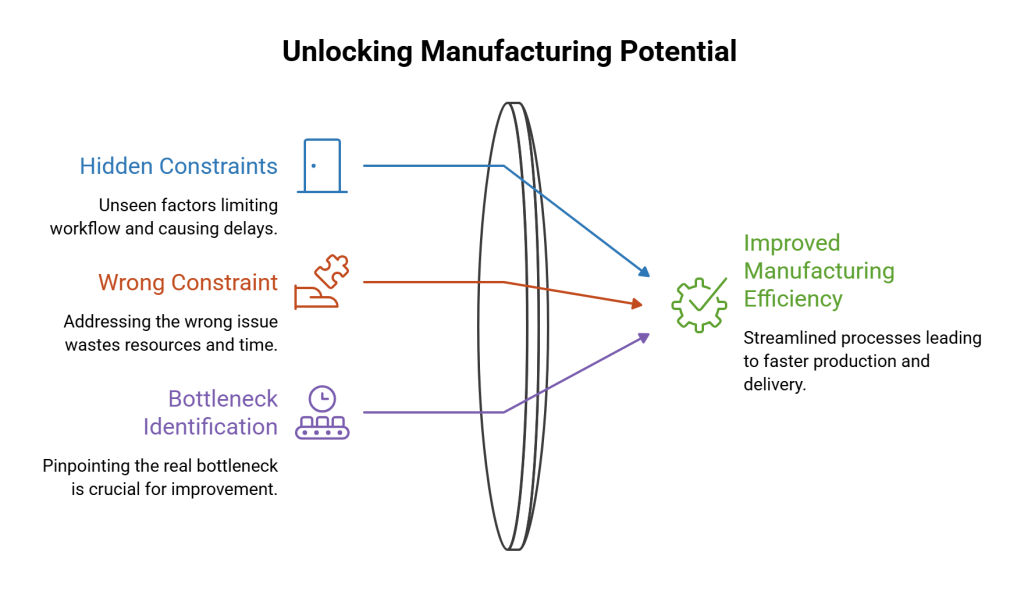
That is your bottleneck. Finding the real bottleneck isn’t always as simple as identifying the busiest machine or department. The constraint may be hidden in a queue, an approval, a material shortage, a scheduling practice, rework, or a handoff between departments. If you solve the wrong constraint, you can spend significant time and money without meaningfully improving lead time, throughput, or customer delivery.
What Is a Bottleneck in Manufacturing?
A manufacturing bottleneck is a step, resource, process, or constraint that limits the overall flow or output of an operation. Imagine a process with five steps. If Step 3 can consistently process only 20 orders per day while the other steps can handle 40, Step 3 may be the bottleneck. But manufacturing bottlenecks aren’t always this obvious. The constraint could be:
- A machine with insufficient available capacity
- A skilled employee who must approve or complete certain work
- Material that isn’t available when needed
- Incomplete engineering information
- A quality inspection queue
- Long changeover times
- Excessive rework
- Too much work released into the process at once
- An approval sitting in someone’s inbox
- A department receiving incomplete information
- A process that depends on one person with specialized knowledge
The key is to look at how work actually moves through the business, not simply where people appear to be the busiest.
The Busiest Department Isn’t Necessarily the Bottleneck
A department can be extremely busy without being the constraint that limits your overall operation. For example, your production team may be working at nearly full capacity, leading management to conclude that production needs another employee. But when you follow orders through the process, you discover that production is frequently waiting for engineering approvals. Adding another production employee won’t solve an engineering delay.
The bottleneck isn’t necessarily where the most work is happening. It’s where the flow of work is being restricted. Instead of asking only, “Which department is busiest?” ask, “Where is work consistently waiting, accumulating, or being prevented from moving forward?” That question often leads you much closer to the real problem.
7 Signs You May Have Found a Bottleneck
Your operation is probably already giving you clues. The challenge is knowing what to look for.
1. Work Keeps Piling Up in One Area
Persistent queues are one of the clearest signals. For example, look for work orders accumulating in front of a particular machine, in an engineering queue, at inspection, in purchasing, before shipping, or while waiting for an approval. Don’t stop at identifying the queue. Ask why the work is accumulating there.
2. One Resource Is Consistently at or Near Capacity
A machine, employee, or department that is constantly overloaded may be a constraint. But utilization alone doesn’t prove you’ve found the bottleneck. For example, a highly utilized employee may be spending significant time correcting errors, searching for information, answering repeated questions, handling work that should have been completed earlier, or performing tasks that could be standardized or delegated. Before adding capacity, understand what is consuming that capacity.
3. Other Employees Are Frequently Waiting
Bottlenecks create more than queues. They can also create idle time elsewhere. For example, if employees regularly say “we’re waiting… on engineering… on material…for an inspection… for the work order… for someone to make a decision”, then you may have identified an important constraint. The people doing the work often know where the process breaks down. Their experience should be considered alongside your operational data.
4. Expedited Orders Constantly Disrupt the Schedule
If your operation is frequently expediting orders, ask why. One late order gets pushed ahead. Another priority changes. A job is moved. Something else gets delayed. Before long, employees are spending significant time managing the schedule instead of following a stable flow of work. Constant expediting can indicate problems with capacity, scheduling, material availability, prioritization, lead-time expectations, and bottlenecks elsewhere in the process. Expediting may be a symptom of the constraint, not the solution to it.
5. Rework Keeps Consuming Capacity
Rework doesn’t just create a quality problem. It consumes the same resources you are trying to use to meet demand. A failed order might follow this path (Production → Inspection → Failure → Investigation → Rework → Reinspection → Approval → Shipment). That means additional production time, inspection time, employee time, and potentially additional material. If rework is concentrated around a particular process, product, or machine, it may be contributing to the bottleneck or creating one. First-pass yield and rework should therefore be part of any serious bottleneck analysis.
6. One Person Has to Approve or Handle Everything
Not every bottleneck appears on a production report. For example, consider the employee who approves every drawing, releases every order, handles every quality issue, knows how to troubleshoot a critical machine, or is the only person who understands a complicated customer process. That person may be highly productive, but if every order must pass through them, their availability becomes part of your process capacity. This creates both an operational constraint and a potential key-person risk.
7. Problems Appear When Demand Increases
Some constraints remain hidden when demand is low enough for the operation to absorb normal variation. As demand increases, you may suddenly see growing queues, longer lead times, more work in process, more expediting, increased overtime, schedule instability, and more customer complaints. That doesn’t necessarily mean your team became less productive. You may simply have reached the point where an existing constraint can no longer absorb normal demand variation.
Look Beyond the Production Floor
One of the biggest mistakes in bottleneck analysis is focusing only on machines and production employees. Your customer’s order doesn’t begin when a machine starts running. The process could look like (Customer request → Sales → Engineering → Quoting → Approval → Purchasing → Material → Scheduling → Production → Inspection → Shipping). Every step can create a constraint. For example, a manufacturer may have a three-day production time but a two-week order-to-delivery time. The question to ask is, “Where did the other nine business days go?” The answer might be engineering approval, material availability, production scheduling, inspection, customer clarification, internal approvals, rework, departmental handoffs. The bottleneck may be occurring before production ever begins.
Processing Time vs. Waiting Time
One of the most useful ways to investigate a bottleneck is to separate processing time from waiting time. Suppose an order requires 30 minutes of engineering review, 1 hour of purchasing activity, 3 hours of production, 30 minutes of inspection, 30 minutes of shipping preparation. That’s only 5.5 hours of active work.
Yet the customer receives the order 10 business days later. The difference is where your investigation should focus. The order may have spent most of its elapsed time waiting for information, approval, material, production capacity, inspection, another department, a customer response, a priority decision. If you only measure processing time, you can miss the majority of the customer’s actual wait.
A Simple Way to Find the Real Bottleneck
You don’t need sophisticated software to begin. Take a recent order, ideally one that was late or took significantly longer than expected, and follow it from beginning to end. Document what actually happened, not what the procedure says should have happened. For each major step, ask:
- When did the work arrive?
- When did someone actually begin working on it?
- How long did the work take?
- What was it waiting for?
- Did it have to go backward to another department?
- Did the priority change? If so, why?
- Did rework occur?
- Where did the largest queue develop?
Then repeat the exercise with several orders. You’re looking for patterns, not a single unusual order.
Use Data to Confirm What You See
Employee feedback is valuable, but combine it with operational data whenever possible. Useful measures include:
- Total lead time
- Processing time
- Queue/waiting time
- Work-in-process (WIP)
- Production throughput
- Machine downtime
- Changeover time
- First-pass yield
- Rework
- Schedule changes
- Expedited orders
- Material shortages
- Approval time
- On-time delivery
You don’t necessarily need an expensive analytics platform to get started. A spreadsheet containing a sample of recent orders can reveal patterns that aren’t obvious in a high-level KPI. The purpose isn’t to collect more data. It’s to understand where time and capacity are actually being consumed.
Be Careful With “We Need More Capacity”
“We need more capacity” may be the right answer. But it should be a conclusion, not an assumption. Before investing in equipment or labor, ask “Is the resource truly the constraint?” For example, suppose a machine operates 95% of the available time and a consistent queue forms in front of it. You may have a legitimate capacity constraint. But what if that machine is only running 70% of the time because, material isn’t ready, operators are waiting for instructions, jobs aren’t scheduled effectively, changeovers take too long, quality problems stop production, maintenance isn’t planned, engineering information is incomplete. In that case, you may have an availability or process problem rather than a simple capacity problem. You don’t want to make a significant investment to solve the wrong problem.
What Happens After You Find the Bottleneck?
Finding the bottleneck is only the beginning. The next question is, What is preventing this constraint from performing at the level the business needs? Depending on what you find, the solution might involve:
- Redesigning the workflow
- Eliminating unnecessary steps
- Improving scheduling
- Changing work-release rules
- Reducing changeover time
- Improving material availability
- Standardizing work
- Reducing rework
- Improving information handoffs
- Cross-training employees
- Clarifying decision authority
- Automating a specific task
- Adding capacity
Sometimes the answer is surprisingly simple. Other times, the constraint really does require additional people, equipment, technology, or investment. The important part is knowing which situation you’re dealing with before you act.
Don’t Fix One Part of the Process Without Looking at the Whole
Suppose you increase the output of an upstream process by 30%. That sounds like an improvement. But if the next process cannot handle the additional work, you’ve simply created a larger queue. You haven’t eliminated the problem. You’ve moved it.
That’s why effective bottleneck analysis considers the flow of work across the entire system. The goal isn’t to make every department as busy as possible. The goal is to move work through the business effectively, predictably, and at the rate the customer requires.
What If You Have More Than One Bottleneck?
You may. A constraint can move as demand, product mix, staffing, equipment availability, or other conditions change. For example, Monday: material availability is the constraint, Tuesday: engineering approvals become the constraint, Wednesday: production capacity becomes the constraint, and then Thursday: inspection becomes the constraint. That’s why bottleneck analysis shouldn’t be treated as a one-time exercise. Once that constraint is improved, look again.
The Goal Isn’t to Keep Everyone Busy
This may be one of the hardest concepts for a manufacturing organization to embrace. A busy employee doesn’t necessarily mean the process is productive. A busy machine doesn’t necessarily mean the business is meeting customer demand. A full production schedule doesn’t necessarily mean the operation is flowing efficiently. And a large amount of work in process doesn’t necessarily mean you’re producing more. The goal is not maximum activity. The goal is effective flow. Your customers don’t care how busy your operation was. They care whether you delivered the right product, at the right quality, when you said you would.
The ClarityShaping Approach
At ClarityShaping, we believe improvement should begin with understanding the problem—not immediately prescribing a solution. When a manufacturer is experiencing long lead times, late orders, capacity concerns, or inconsistent throughput, we look at questions such as:
- Where does work enter the process?
- Where does it wait?
- Where does it accumulate?
- Where does information get lost?
- Where do priorities change?
- Where does rework occur?
- Where are decisions delayed?
- Where is capacity actually constrained?
- Which problems are symptoms, and which are causes?
From there, we can determine where improvement efforts are most likely to make a meaningful difference. The answer may be technology. It may be additional capacity. It may be a scheduling change, better documentation, process redesign, or something much simpler. The right solution depends on the real problem.
Before You Add Capacity, Find the Constraint
If your manufacturing operation is struggling with late orders, growing work in process, long lead times, or constant schedule changes, don’t assume the answer is automatically more people or equipment. Start by finding where the work is actually being constrained. Look at the entire journey—not just the production floor. Measure processing time and waiting time. Talk to the people doing the work. Use your data to confirm what you’re seeing. And most importantly, make sure you’re solving the problem that’s actually limiting your operation. Because when you find the real bottleneck, you can stop treating symptoms and start improving the process where it matters most. That’s where meaningful operational improvement begins.
How ClarityShaping Can Help
ClarityShaping helps manufacturing leaders identify process constraints, uncover hidden delays, and determine where improvement efforts can have the greatest impact. If you know your operation isn’t performing as well as it should, but you’re not sure where the problem really is, we can help you find it.
ClarityShaping


Leave a comment