By ClarityShaping
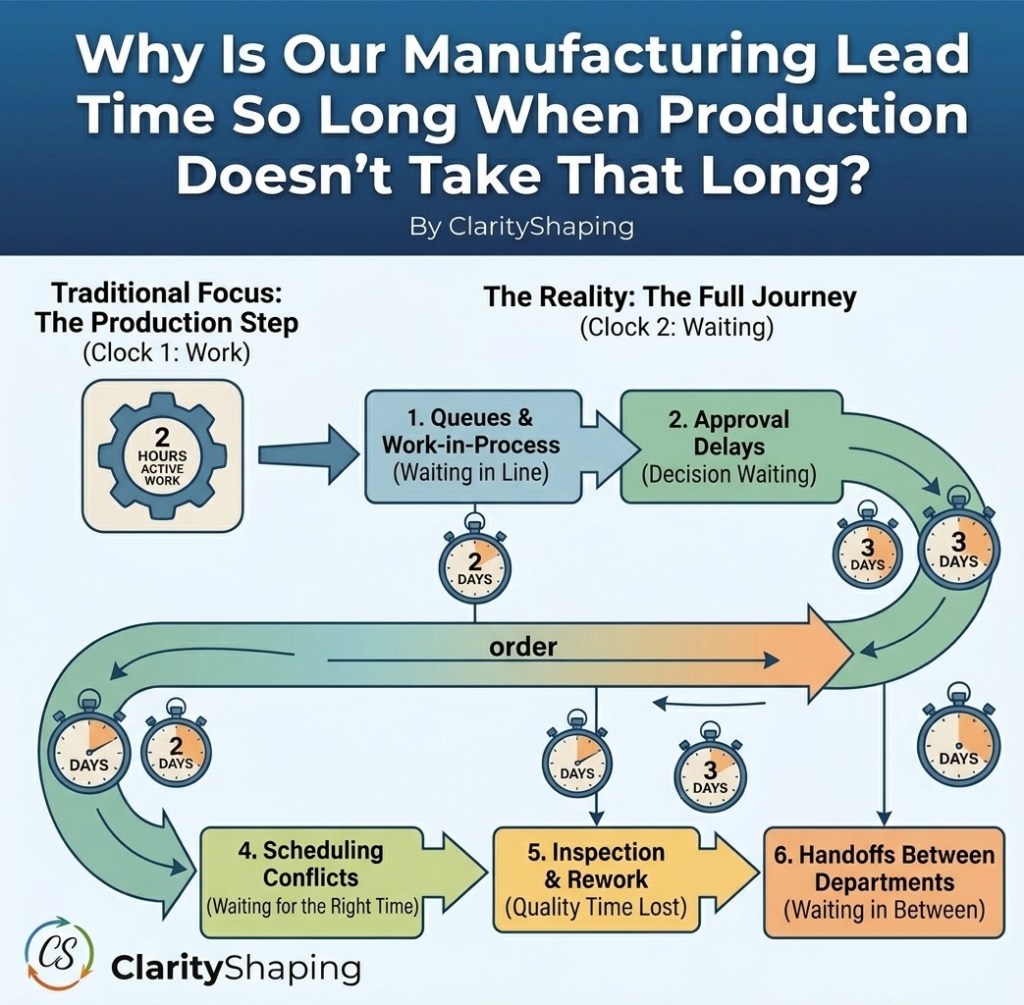
If you ask a manufacturing leader how long it takes to produce a product, the answer may be surprisingly short. “Once it gets to the machine, it takes about two hours.” Yet the customer may be waiting two weeks, or even longer, to receive it. So where did the rest of the time go?
This is one of the most frustrating questions facing manufacturing leaders today. Your team is working. Your equipment is running. Orders are moving through the facility. And yet customers are still waiting longer than expected for their products.
The problem may not be how long it takes to produce the product. It may be how long the product spends waiting to be produced. Understanding that distinction is one of the first steps toward reducing manufacturing lead time.
Processing Time Isn’t the Same as Lead Time
One of the most important distinctions in manufacturing operations is the difference between processing time and total elapsed time.
Processing time
Processing time is the amount of time someone or something is actively working on the product.
For example:
- 30 minutes of machining
- 20 minutes of assembly
- 15 minutes of testing
- 10 minutes of packaging
The total processing time might be less than two hours.
Total elapsed time
Total elapsed time is everything that happens from the beginning of the process to the end. That includes both active work and all the time the order spends waiting.
For example:
| Activity | Time |
| Customer order review | 30 minutes |
| Waiting for engineering approval | 2 days |
| Waiting for material | 3 days |
| Waiting for production capacity | 2 days |
| Actual production | 2 hours |
| Waiting for inspection | 1 day |
| Rework | 2 hours |
| Waiting for packaging/shipping | 1 day |
| Total elapsed time | ~9 days |
The product may only require a few hours of actual work, but the customer experiences the entire nine-day journey. That difference is where many manufacturing organizations have significant opportunities for improvement.
The Question Isn’t Just “How Long Does It Take?”
A common approach to improving manufacturing performance is to ask, How can we make this operation faster? That is a reasonable question, but it may not be the most important one.
A better question is, Where is the order spending time when nobody is actively working on it? The answer may reveal that the largest opportunities have little to do with machine speed. An order can spend hours or days:
- Waiting in a production queue
- Waiting for an engineering decision
- Waiting for materials
- Waiting for a purchase order
- Waiting for someone to approve something
- Waiting for a production slot
- Waiting for quality inspection
- Waiting for information to move between departments
- Waiting for another department to complete its work
- Waiting because priorities changed
- Waiting because something was entered incorrectly earlier in the process
Every one of these delays adds to the customer’s lead time.
And because these delays often occur between departments rather than inside a single department, they can be difficult to see.
Six Places to Look When Lead Time Is Too Long
If your manufacturing operation is struggling with turnaround time, these six areas are worth examining.
1. Queues: How Long Is Work Waiting?
Imagine a machine can process an order in one hour. That sounds efficient. But if the order sits in front of the machine for three days before the machine becomes available, the customer doesn’t experience a one-hour turnaround.
They experience more than three days. This is the difference between capacity utilization and flow. A busy operation isn’t necessarily an efficient operation.
In fact, keeping every person and machine busy can sometimes create larger queues and longer lead times. When work continually accumulates between process steps, employees may be working hard while customer orders continue to age.
This is why it is important to measure not only:
- How long a task takes
- How busy a machine is
- How many units are produced
but also:
- How long work waits
- How much work is in process
- Where queues form
- How long orders remain in each stage
A queue is not simply an inconvenience. It is part of your customer’s lead time.
2. Approvals: How Much Time Is Spent Waiting for Decisions?
Manufacturing processes often contain more approvals than leaders realize. A job may require approval from:
- Engineering
- Quality
- Purchasing
- Sales
- Management
- The customer
- Regulatory or compliance personnel
The actual decision might take five minutes. But the order could sit for two days waiting for someone to make that five-minute decision. This creates an important question, Are we measuring the time required to make the decision, or the time the customer waits for the decision?
Both matter, but they represent different improvement opportunities. You may not need to eliminate the approval itself. You may need to improve how the approval is triggered, who is responsible for it, what information is provided, or how quickly exceptions are escalated.
For example, consider a process where an engineering review takes 20 minutes but occurs only after a complete package of information has been assembled. If information is routinely missing, the engineering team may spend very little time actually reviewing the job but a great deal of time waiting for clarification. The problem isn’t necessarily engineering capacity. The problem may be the process feeding engineering.
3. Material Availability: Is Production Waiting for What It Needs?
Few things are more frustrating than having customer demand, available labor, and available equipment, but being unable to start because the necessary material isn’t available.
Material-related delays can occur because:
- Materials weren’t ordered in time
- Supplier lead times weren’t considered
- Inventory records aren’t accurate
- Purchasing wasn’t notified soon enough
- Specifications changed
- Materials arrived but weren’t released
- Materials are physically available but difficult to locate
- The wrong material was ordered
- Incoming inspection hasn’t been completed
Each issue can create downstream consequences. And the delay may not appear to be a purchasing problem. Production may see it as a scheduling problem. Sales may see it as a delivery problem.
The customer sees it simply as: “Where is my order?”
This is why looking at the entire process is so important. A delay at one step can become a problem for several departments downstream.
4. Scheduling: Is the Work Waiting for the “Right” Time?
Production scheduling is often treated as a technical planning exercise. But scheduling decisions can have a significant effect on customer lead time. For example, a job might be ready to run but get pushed behind other work because:
- A larger order takes priority
- A machine is being used for another product
- The setup isn’t considered worthwhile for a small batch
- An expedited order jumps ahead
- Materials arrived later than expected
- A customer’s requested date changed
- The schedule was built around departmental priorities rather than overall flow
Over time, this can create a familiar cycle:
- Orders are delayed.
- Customers call.
- Someone marks an order as urgent.
- The urgent order moves ahead.
- Other orders are delayed.
- More customers call.
- More orders become urgent.
- The schedule becomes increasingly difficult to manage.
Eventually, the organization is spending substantial time expediting work instead of improving the process that creates the need for expediting. If your team regularly asks, “Can we get this order pushed through?” that may be a symptom worth investigating.
5. Inspection and Quality: Is Quality Adding Time—or Preventing a Larger Problem?
Quality is an essential part of manufacturing. The objective should never be to eliminate necessary quality controls simply to make an order move faster.
Instead, the question is:
How can we maintain the required level of quality without creating unnecessary waiting or rework?
Consider an order that spends one day waiting for inspection. If the inspection itself takes 30 minutes, there may be an opportunity to examine the process surrounding the inspection.
But there is another question that may be even more important:
Why does the product need to wait for inspection at that particular point?
Depending on the product, process, customer requirements, and regulatory environment, there may be opportunities to improve:
- Inspection scheduling
- Information availability
- First-piece approval
- In-process quality checks
- Documentation
- Error prevention
- Communication between quality and production
And then there is rework. If a product fails inspection, the lead time clock continues to run. The product may have to go back to production, wait for another available slot, be corrected, and then return to inspection. A quality problem that takes 30 minutes to correct can create days of additional elapsed time if the product has to re-enter a queue. This is why rework should be viewed not only as a quality issue, but also as a lead-time issue.
6. Handoffs: What Happens Between Departments?
Some of the biggest delays in manufacturing occur at the boundaries between departments.
Think about the path an order may take, Customer → Sales → Engineering → Purchasing → Production → Quality → Shipping → Customer
Every arrow represents a handoff. And every handoff creates an opportunity for:
- Missing information
- Miscommunication
- Duplicate data entry
- Questions
- Waiting
- Rework
- Conflicting priorities
- Unclear responsibility
The actual work performed by each department may be efficient. But the overall process can still be slow. This is one of the reasons department-by-department improvement doesn’t always produce the expected results. Sales can improve its process. Engineering can improve its process. Production can improve its process. Quality can improve its process. And the customer can still experience a slow overall process. Why…because the delays may exist between the departments.
Look at the Entire Customer Journey
One of the most valuable exercises a manufacturing organization can perform is to follow an order from beginning to end.
Start with:
“The customer places an order.”
Then follow it through every step until:
“The customer receives the product.”
Don’t just document what is supposed to happen. Document what actually happens.
Ask questions such as:
- When does the order enter the process?
- When does someone first touch it?
- How long does it wait before being reviewed?
- What information is missing?
- How many approvals are required?
- Where does engineering become involved?
- When are materials ordered?
- How long does the order wait for materials?
- When is it scheduled?
- How long does it wait for production?
- How long does actual production take?
- How long does it wait for inspection?
- How often does it require rework?
- Where does information get entered more than once?
- How many times does the order change hands?
- When does shipping receive it?
- How long does it wait before leaving the facility?
The answers can be eye-opening. You may discover that the actual processing time represents only a small fraction of the customer’s total wait.
Don’t Improve What You Haven’t Measured
One of the most common mistakes in operational improvement is jumping directly to a solution. A company experiences long lead times and immediately considers:
- Buying another machine
- Hiring additional employees
- Adding another shift
- Purchasing new software
- Increasing inventory
- Outsourcing work
- Automating a process
Sometimes those are the right answers. But sometimes they address the symptom rather than the underlying problem. Before investing in a solution, it is worth understanding where the time is actually being lost.
For example, If a machine is operating at capacity for eight hours a day but orders spend four days waiting to reach it, buying another machine might help, but it may not address other delays occurring elsewhere.
Likewise, hiring more people may increase capacity in one department while creating an even larger queue downstream.
The first question should be: What is actually limiting our ability to deliver?
The answer should be based on the flow of work and evidence from the process—not simply the most visible problem.
A Simple Way to Think About Manufacturing Lead Time
Think of every customer order as having two clocks.
Clock #1: Work
This is the time someone is actively doing something that moves the product toward completion.
Clock #2: Waiting
This is the time the order spends waiting for something else to happen. Your customer experiences both clocks.
If you only optimize Clock #1, you may make individual activities faster without meaningfully improving delivery performance.
But if you reduce unnecessary waiting in Clock #2, the customer’s experience can improve dramatically, even if the actual production steps don’t change.
That is why reducing lead time isn’t always about making people work faster. Sometimes it’s about making the work wait less.
What Should Manufacturing Leaders Measure?
If reducing lead time is a priority, start by looking beyond traditional production metrics. Consider measuring:
Total lead time
How long does it take from customer order to customer delivery?
Processing time
How much time is the product actually being worked on?
Waiting time
How much time does it spend waiting between steps?
Queue time
How long does work wait before entering each major process?
Work in process
How much unfinished work is sitting throughout the operation?
First-pass yield
How often does a product move through the process without requiring rework?
Rework time
How much additional time is created by quality problems?
Expedite frequency
How often does the organization have to intervene manually to keep orders moving?
On-time delivery
Are customers receiving products when promised? Taken together, these measures provide a much more complete picture than any single efficiency metric.
The Goal Isn’t Simply to Make Your Factory Faster
The goal is to create a process that moves work predictably and efficiently from customer request to customer delivery.
That requires looking beyond individual departments.
It means understanding the entire flow: Customer Need → Order Entry → Engineering → Materials → Scheduling → Production → Quality → Shipping → Customer
Then asking:
Where is the work waiting?
Why is it waiting?
What causes that waiting?
What happens when something goes wrong?
How often does the same problem occur?
What would happen if we removed or changed that step?
Those questions can reveal opportunities that aren’t obvious when each department is viewed independently.
When “We Just Need More Capacity” Isn’t the Full Answer
Manufacturers understandably look toward additional capacity when customers are waiting too long. But before making a significant investment, it can be valuable to determine whether the organization has a true capacity constraint, or a flow problem.
If your operation is struggling with:
- Increasing customer lead times
- Frequent expediting
- Orders waiting for approvals
- Material-related delays
- Production scheduling conflicts
- Excessive work in process
- Rework
- Communication problems between departments
- Inconsistent customer delivery dates
- New orders taking too long to enter production
the first step may not be adding more resources. It may be understanding how the current process actually works.
The ClarityShaping Perspective
At ClarityShaping, we believe meaningful operational improvement starts with understanding the problem before prescribing the solution. A manufacturing organization doesn’t necessarily need every process to move faster.
It needs the right work to move through the organization with less unnecessary waiting, fewer obstacles, and greater predictability.
That starts by examining the process from the customer’s perspective and understanding what happens from the moment an order enters the organization until the product reaches the customer.
Sometimes the answer is a technology investment. Sometimes it’s additional capacity. Sometimes it’s a scheduling change, a clearer approval process, better information, improved handoffs, or a change to the way work is prioritized.
And sometimes the biggest opportunity is something much simpler that has been hidden in the process for years. The key is finding the right answer before investing in the wrong one.
Is Your Manufacturing Process Taking Too Long—or Just Waiting Too Much?
If your team knows how long it takes to manufacture a product but struggles to explain why customers are waiting days or weeks longer, that gap deserves attention.
The question isn’t simply, “How can we make production faster?”
A better starting point may be, “Where is the customer’s order spending time, and why?”
That question can change the conversation from reacting to late orders to understanding, and improving, the process that creates them.
ClarityShaping helps organizations identify process constraints, uncover opportunities for improvement, and develop practical changes that improve efficiency, turnaround time, and service delivery. When the problem is understood clearly, the path to improvement becomes much easier to see.


Leave a comment